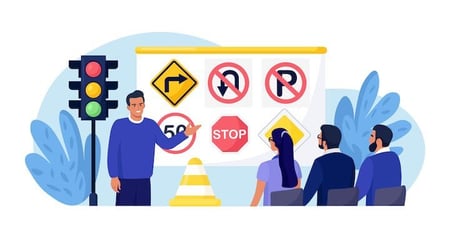
When Should Companies Require Fleet Driver Retraining? 7 Key Triggers

A crash, citation, or near miss can leave fleet managers asking a hard question: “Was this a one-time mistake, or is this a sign we need to step in?”
That question matters because retraining is not just about correcting one driver. It is about preventing the next incident. A work-related crash can affect employee safety, vehicle availability, insurance pressure, customer service, delivery schedules, and company reputation.
Even a minor parking lot crash can create repair costs, downtime, and paperwork that pulls managers away from daily operations.
The Network of Employers for Traffic Safety reports that motor vehicle crashes cost U.S. employers $62 billion annually in direct crash-related expenses, including medical care, liability, lost productivity, and property damage.
That makes driver retraining a business decision as much as a safety decision.
Pacific Driver Education helps Oregon businesses build practical, people-first fleet safety programs that respond to real driving risks.
The goal is not to punish drivers after something goes wrong. The goal is to use the event as a clear signal, then provide the right training before the same risk shows up again.
1. Require Retraining After a Preventable Crash
A preventable crash should almost always trigger some level of review and training. This does not mean the company should assume blame before the facts are known.
It means the company should ask what happened, what contributed to it, and whether the driver needs coaching before returning to normal driving duties.
Examples may include backing into a fixed object, rear-ending another vehicle, making an unsafe lane change, failing to yield, driving too fast for conditions, hitting customer property, or causing repeated low-speed damage.
Even if the crash seems minor, it may point to a larger habit such as poor scanning, rushed backing, weak space management, or distracted driving.
OSHA’s employer motor vehicle safety guidance says periodic refresher training can help prevent driver complacency and keep drivers focused on safe driving principles.
OSHA also describes adherence to a driver training schedule as a leading indicator in preventing work-related vehicle crashes.
The right response depends on the event.
A minor mirror strike may call for a short coaching session and backing refresher.
A rear-end crash may require behind-the-wheel coaching on following distance, scanning, and speed control. An injury crash may require a deeper investigation, supervisor review, and return-to-driving plan.
2. Require Retraining After a Serious Citation
A serious citation is a clear warning sign. It shows that a driver may have broken a traffic law while representing the company on the road. Even if no crash happened, the behavior may increase the chance of a future crash, claim, or injury.
Citations that should trigger review include speeding, distracted driving, failure to obey a traffic control device, following too closely, unsafe lane changes, seat belt violations, failure to yield, reckless driving, or careless driving.
A company may also want to review citations that occur outside work if they affect the driver’s motor vehicle record or company driving eligibility.
Distracted driving is a strong example. NHTSA reports that distracted driving claimed 3,208 lives in 2024 and injured an estimated 315,167 people.
A citation for phone use is not just a paperwork problem. It may reveal a habit that puts the driver, the public, and the company at risk.
Retraining after a citation should match the behavior. Speeding may require coaching on route planning, schedule pressure, and speed management.
A distracted driving citation may require policy review, manager expectations, and practical steps for staying unreachable while the vehicle is moving.
Companies building a broader program can use fleet driver training topics to connect citations with the skills and policies drivers need most.
3. Require Retraining After a Near Miss
A near miss is an event that could have caused a crash, injury, or property damage, but did not. These events are easy to ignore because there is no repair bill, police report, or claim. But for safety leaders, near misses are useful warnings.
Examples include hard braking to avoid a rear-end crash, almost backing into a pedestrian, drifting from a lane, nearly hitting a cyclist, receiving a customer complaint about unsafe driving, or reviewing dashcam footage that shows a close call.
The driver may feel embarrassed, defensive, or relieved. The manager should stay focused on the safety question: what could happen next time if nothing changes?
The AAA Foundation’s 2024 report on near-miss reporting for roadside responders explains that traditional crash data can miss risk because it does not capture near-miss events that happen often.
The report recommends collecting useful context about near-miss incidents so organizations can understand and respond to risks before harm occurs.
Use link: near-miss reporting
Near misses should be treated as coaching opportunities, not automatic punishment. If drivers believe reporting a close call will only get them in trouble, they may stop reporting.
A strong fleet safety culture makes it safe to report risk while still holding drivers accountable for safe behavior.
4. Require Retraining When Data Shows a Pattern
Many companies now use telematics, GPS, dashcams, or driver monitoring systems. These tools can show safety patterns long before a crash occurs. One alert may not mean a driver needs formal retraining. A repeated pattern should get attention.
Common data triggers include repeated speeding alerts, harsh braking, harsh cornering, rapid acceleration, seat belt alerts, following distance warnings, stop-sign events, phone-use alerts, or repeated backing alerts.
The question is not only “Did the system flag something?”
The better question is, “Is this behavior becoming normal?”
OSHA notes that in-vehicle monitoring systems may help reduce crash risk, and that driver feedback with supervisory coaching can reduce risky driving behaviors.
A 2024 study on last-mile delivery road safety also found that telematics should be paired with a proactive safety culture, not used alone as the entire solution.
Data should lead to coaching, not just scorekeeping. If a driver is braking hard every day, the issue may be following distance, route pressure, traffic conditions, schedule design, or poor scanning. Retraining should help identify the cause and improve the habit.
5. Require Retraining After a Policy Violation
Some risky events do not involve a crash or citation. A driver may still violate a company rule that exists to prevent harm. These events should trigger a consistent response.
Examples include using a phone while driving, not wearing a seat belt, carrying unauthorized passengers, driving outside approved routes, skipping vehicle inspections, using a vehicle without permission, ignoring weather or fatigue rules, failing to report damage, or failing to follow post-incident steps.
Policy violations can be frustrating for managers, but retraining should stay focused on prevention.
Discipline may be part of the company’s process, but training answers a different question: what does the driver need to understand or practice so this does not happen again?
For example, a missed inspection may require a refresher on vehicle walkarounds and defect reporting.
A phone-use violation may require a review of communication rules between drivers, dispatch, and managers. A failure to report damage may require a simple incident-response checklist. The goal is to turn policy into clear daily habits.
If a policy violation happens after a crash, supervisors may also need a stronger post-accident response process so testing, documentation, communication, and driver availability are handled calmly and consistently.
6. Require Retraining Before Return to Driving
Some events should trigger retraining before the driver returns to normal routes. This may include a serious crash, injury crash, tow-away crash, repeated preventable incidents, a long break from driving, a change in vehicle type, or an investigation that shows unsafe habits.
A return-to-driving decision should consider the severity of the event, the driver’s current skill level, company policy, insurance requirements, and any regulatory obligations. The goal is not to delay work without reason. The goal is to make sure the driver can return safely.
For regulated commercial motor vehicle operations, post-accident drug and alcohol testing rules may apply in specific situations.
FMCSA says post-accident testing may be required after certain crashes, including fatal crashes and citation-based injury or tow-away crashes. Companies should confirm DOT, FMCSA, state, union, insurance, HR, and legal requirements before making final decisions.
Retraining before return to driving may include a safety meeting, online refresher, ride-along, behind-the-wheel evaluation, route review, or manager sign-off.
A driver who had a backing crash may need a backing evaluation. A driver involved in a speed-related crash may need route planning, following distance, and speed management coaching.
7. Require Retraining When Incidents Repeat
A single event may be a mistake. A pattern is a signal. Repeated incidents should trigger a deeper review because they may show that a driver, route, vehicle, schedule, or policy is creating risk.
Examples include three backing incidents in six months, repeated speeding alerts, multiple customer complaints, the same driver involved in several preventable events, the same route producing repeated close calls, or the same vehicle type showing frequent damage.
When the same risk appears again and again, the company should not wait for a more serious crash before acting.
OSHA’s program evaluation guidance says reported hazards and near misses can be used as quantitative indicators, and that program evaluations may be triggered by incidents such as serious injury, significant property damage, or increased safety-related complaints.
Repeated incidents may not be only a driver problem. They may point to unclear policies, tight schedules, poor route planning, vehicle blind spots, parking-lot design, weak onboarding, or inconsistent manager expectations.
Before choosing a training plan, leaders should ask what is driving the pattern. Companies comparing options can use fleet training cost guidance to understand how program scope changes when risk is more complex.
How Soon Should Driver Retraining Happen?
The timing should match the severity of the event. A serious crash may require immediate removal from driving until the company completes a review. A lower-risk policy violation may only require a short refresher within a set time period.
As a general framework, consider immediate removal from driving after a major crash, injury, suspected impairment, reckless driving, severe citation, unsafe vehicle concern, or any situation where the driver may not be fit to continue.
Within 24 to 72 hours, complete the initial supervisor review, collect facts, document the event, and decide what level of retraining is needed.
If the incident reveals a clear skill gap or unsafe behavior that could happen again right away, retraining should happen before the next unsupervised driving shift.
For lower-severity issues, refresher training or team-wide coaching may happen within 30 days.
The key is consistency. Drivers should know what triggers retraining, managers should know how to respond, and the process should be documented. A predictable response feels fairer and helps reduce confusion after stressful events.
What Should Driver Retraining Include?
Good retraining should match the risk. A distracted-driving citation should not receive the same response as a backing crash. A repeated speeding pattern should not be treated the same as a missed inspection.
Start with the facts. What happened? What behavior or condition created risk? Was the problem skill-based, policy-based, route-based, schedule-based, or vehicle-based? Then choose the training method.
Online refresher training can work well for policy reminders, distracted driving awareness, seasonal safety, and company-wide education.
Behind-the-wheel coaching works better when the company needs to observe driving behavior, correct unsafe habits, or evaluate a driver after an incident. Manager follow-up helps reinforce the standard after training ends.
The training should also be documented. Record what happened, what training was assigned, when it was completed, who reviewed the outcome, and what the next step will be if the behavior continues.
For higher-risk situations, custom fleet training can help match the response to the driver, vehicle, route, and company goal instead of relying on a generic course.
What Companies Should Avoid
There are a few common mistakes that can weaken a retraining program. The first is waiting too long. If a driver has three preventable incidents before anyone steps in, the company has missed earlier chances to coach.
The second mistake is treating retraining only as punishment. Drivers need accountability, but they also need clear expectations and practical support. If retraining feels like shame, drivers may hide near misses or avoid honest conversations.
The third mistake is using the same training for every event. A one-size-fits-all course may be easy to assign, but it may not solve the real issue. A driver who struggles with backing needs different coaching than a driver who speeds, tailgates, or uses a phone behind the wheel.
The fourth mistake is ignoring company factors. Sometimes the driver needs training. Sometimes the company also needs to fix route pressure, unclear communication rules, poor scheduling, unsafe loading practices, or vehicles that are not well matched to the job.
Turn Incidents Into Prevention
A crash, citation, near miss, data alert, policy violation, return-to-driving situation, or repeated pattern can all be a signal that retraining is needed. The point is not to overreact to every mistake. The point is to respond before the same risk becomes a more serious crash, claim, or injury.
You now have a clearer way to decide when retraining makes sense. Look at the severity of the event, whether the behavior could happen again, whether the driver needs skill-building, and whether the company needs to adjust a policy, route, vehicle, or schedule. A fair retraining process helps managers act consistently and helps drivers understand what safer performance looks like.
Pacific Driver Education supports Oregon businesses with fleet safety training, post-incident coaching, and custom programs built around real-world driving needs. If your team has seen recent crashes, citations, near misses, or safety trends, the next step is to choose a training plan that fits the risk.
If your company is ready to act, fleet safety training can help drivers build safer habits and give managers a clearer process for reducing risk.
Need to compare training options first? A custom fleet training plan can be built around your drivers, vehicles, routes, and safety concerns.
Topics Covered
Drive with Confidence: Enroll in a Course Today
Master the road with expert-led driver education.